


1904 School Building
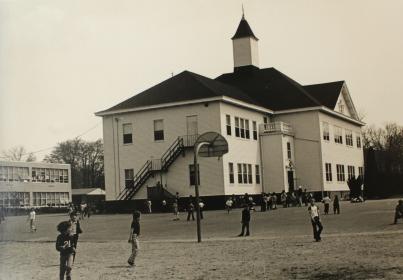
Ashaway School - the 1904 building
by Lauri Arruda
The new school was the pride of Ashaway. Built in 1904, it’s classrooms eased the overcrowding in the smaller schools around the Ashaway area.
The school day was centered around farm work, for this town had many farms and all the children had chores to do before and after school. School started after harvest time in September and usually ended at the beginning of May for planting time.
On June 22, 1905, the school had only three graduates, because most kids quit school and went to work.
Found in the Westerly Sun, 13 February 1908, “If the plans of the National Board for the promotion of rifle practice and the National Rifle Association meet with the approval of Congress, a great impetus may be given to school boy rifle practice. A certain teacher was already taking the boys out for shooting practice. He was fired. Not for what he was doing, but because he left the girls alone to fend for themselves.”
It was a very different time.
The only information that has been found about the early days of the school (1924) is from a book written by George T. Davis. In his book, “The Devil in the Second Pew,” he briefly describes the school yard surrounding the building.
“The school was a large two-story frame building. At each end, there was a large tube which was used for a fire escape. During the summer, we could use them as slides by climbing inside them. The playground was larger than a football field, but it was pretty well grown-up with hummocks of grass and wild dew berries.
Across the school yard was a big sand bed, surrounded by white birch trees whose trunks were about six inches in diameter. We tied a rope to the top of these tress to form a catapult. To do this, two or three boys would pull the tree as near to the ground as they could away from the sand bed. Then another boy would climb as near as he could to the top of the tree and spread eagle facing the sand pit. On the word “Go” the boys would let go of the rope. The boy would be catapulted in the air, land on his belly, and slide for several feet down the sand bank.” Those were the days when there was no playground equipment for recess and children used their imagination at play. Games such as tag, dodge ball, marbles, jump rope, hop scotch, and red rover. One former student, Brenda (Perrin) Stone liked it when playground equipment was installed at the school. She wrote her favorite was the monkey bars and the whirl merry-go-round.
There was an informal baseball game the boys played on the weekends. The name of the team was called “the Ashaways.” Older folks I have interviewed told of gathering around the big field by the school and rooting for their home team.
In later years, more formal activities were offered to the students. The photograph below is of the girl’s soccer team.
Front row, left to right; Marjorie Dinwoodie; Beverly Coon; Tina Weeden; Ellen Lute; Theresa Cayer; Betty Champlin, Cpt; Nancy Manfredi; Florence Abruzzi; Joyce Dumelow; Jackie Champlin.
Back row, left to right; Mrs. Bowman (coach); Shirley West; Betty Taylor; Hazel Brayman; Patty Host; Doris Davis; Mildred Babcock, Cpt; Dagma Baldwin; Barbara Holberton; Margot Savey; Marilyn Panciera; Janice Kenyon; Lois Eccleston; Ruby Palmer, manager.
The photograph below is of the boy’s football team.
Front row, left to right; Dick Palmer; Jimmy Main; Wilfred Cayer; Kenneth Panceira; Dudley Arzamarski; George Hill, Cpt; Raymond Richie; Benson Bliven; Bill Church; Richard Clarke; Francis Bowman; Clifford Kenyon.
Back row, left to right; Ronald Dufour; Richard Grills; Lawrence Jacobson; Roland Austin; Dickie Brady; Gilbert Kenyon; Gillette Kenyon; Russell Francis; Earle Travis; Alfred Kennedy; Fred Savage; Kenneth Strong; Joey Park.
I have been told there was few snow days but during the 1938 Hurricane, only a handful of students could make it home. The remaining students with their teachers hunkered down to spend the night at the school. In the morning, parents made their way to retrieve their children. The older children were in awe of the destruction that lay before them.
As with other schools there are so many memories, good and bad of the Ashaway Elementary 1904 building. Let me share a few…Brenda (Perrin) Stone writes, “We always went out to recess, no matter how cold it was. We had the snow suits and boots for it, It took the teacher more time to get into all that and out again than time we had on the playground.” She adds her dislike to the school lunches, bringing up a frequently repeated story of “Welsh Rabbit.” This dish consisted of crumbled saltine crackers, with tomato soup poured over the top. Joanne (Roode) Kenyon writes, “At lunch, we all sat at one long table with the teacher at the head of the table. Each class had their own table. Before lunch we all said grace, “God is great, God is good, let us thank him for this food. Amen” Rae Anna (Foberg) Gray remembers that in kindergarten, her class made a large paper mache’ donkey, one that was big enough for each child to individually sit upon. She stated there was a lot of activities at school, such as school plays and musicals. On May 1st, each year, the school children celebrated May Day and made a May Pole to dance around. (This signified winter was over and now planting time could begin)
Many former students mentioned a teacher who seemed to be everyone’s favorite, Mrs. Jeanne Banning.
There are students who remembered their teachers quite differently. Gordon Oates explained to me that in his day, punishment doled out with no interference from parents. In his day, everyone carried a cloth “hanky” which was used to blow your nose in, which would be used over and over again. (the hankies were washed on laundry day) There was Kleenex, but was too expensive to purchase. In one class, his hands were hit over and over with a wooden ruler, because he forgot his hanky. He also had to wear toilet paper around his neck for the rest of the day.
Gordon Wright told that when he was in fourth grade, he borrowed a book from the school library called “The Wizard of Oz.” After school, he was playing on the slide and after a while decided to go home. While he was eating supper that night it occurred to him he had left the book on top of the slide. As he lay awake in bed that night, worrying about the book and hoping it would be there the next morning, he heard the rain…the next day the book was right where he left it, but the rain had swelled it to three times its size. Of course, the book had to be paid for which was a financial burden because his family did not have much money.
Let us not forget the tradition of ringing of the bell on Halloween.
It began in 1910, when the school boys would climb atop the three story school and ring the large bell that hung in the cupola on the roof. Every Halloween police had tried to catch the culprit but never succeeded. One year, though, the police were ready and waiting. But, having been tipped off, the area boys had climbed up to the bell that afternoon and attached clear fishing line to the clapper. They ran the line into the woods behind the school, and when the time was right, pulled the fishing line and rang the bell for all it was worth.
In 1970, after 60 years, the Ashaway bell was removed from the belfry and placed on a cement foundation in front of the school. A few days before Halloween some young people, who shall remain nameless, drove up to the bell and loaded it into the back of a pickup truck. Where the bell disappeared to was a mystery and was the big news around town. It was probably the only news the town had had for months…
True to tradition, the bell rang on Halloween night. From the back of the pickup truck which was being driven all over town. Later in the evening, the bell was discovered tied to a tree on Main Street. It was high enough to be able to ring the bell one last time. The bell now sits on a cement block on the school property.
Today, the school stands empty.
The School District’s responsibility is to maintain all school buildings. That was not done with the 1904 building. The expense was too great. There was asbestos to be removed, a plumbing system to be replaced, a complete overhaul of the entire school and to be ADA compliant, an elevator would have to be installed. Unexpectedly, the keys to the school were dropped on the counter in the Town Clerk’s office one morning, shifting the burden solely to the town of Hopkinton and consequently the taxpayers. Many uses have been proposed for the building, but the RI Department of Education stepped in and shot down all ideas because the building is too close to the Ashaway Elementary School.
So now, when the time is right, the wrecking ball will do its job and all we will have is our memories.
Thank you, Laurie Arruda for sharing your words about the beloved school.
Present Day
The decision to demolish the 1904 School building was not made overnight, nor was it done light-heartedly. The fate of the 1904 Building was one that was determined over decades of due diligence and multiple investments of tax payers’ money to seek other possible options for the structure. The decision made by the Town Council to demolish the building was one that was ultimately driven by two fundamental factors. The first factor is that the Town has exhausted all other possible options. The Town hired architects to complete a feasibility study in 2009 and 2014, both studies came up with the same conclusion that it would be too costly to reuse the building as a school facility given the conditions of the building, the presence of hazardous materials, and that the proximity to the existing Ashaway Elementary School, which would be too problematic for commercial or residential uses. The previous Town Councils attempted, on multiple occasions, to find funding to repair the building as well as seek other alternative uses for the structure once it was determined unsalvageable, but unfortunately, those efforts came up fruitless.
The second fundamental factor that led to the Town's decision to demolish the building was the overwhelming concerns from previous Town Council members, the Chariho School District, Emergency Services Representatives, and the public at large for the children's safety. The primary concern is the location of the building which is just 30 feet from the current Ashaway Elementary School, making the site a severe threat to the children's safety.
One uncontested fact by all parties involved is that the 1904 Building will be missed, and therefore the proper respect needs to be shown to the building. Funding has been set aside to ensure that the Town preserves the memories for future generations by creating a green area where the facility once stood.